What we discuss at The jbrains Experience
Examples of what we really discuss and grapple with in chat, in the forum, and during Office Hours.
Privacy & confidentiality
None of the content on this page has been published without the express, enthusiastic consent of the members of The jbrains Experience. Some members have graciously agreed to publish some of our discussions in order to help you understand more about what you can help with or discuss as part of your membership.
Technical Skills: Crafting effective marketing messages
Not every discussion at The jbrains Experience centers on leadership, communication, and teamwork. We also touch on technical skills, such as writing, software design, and even marketing.
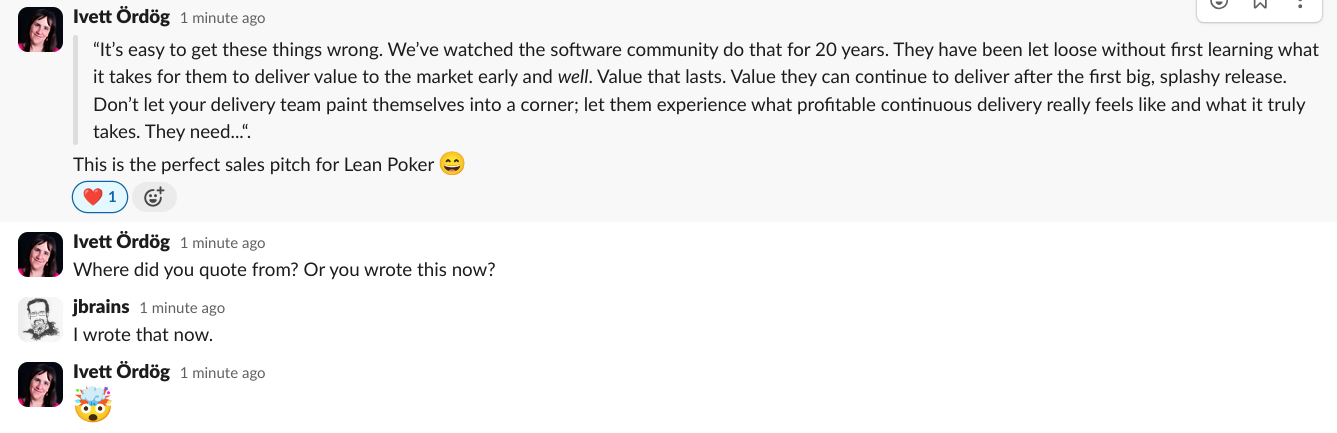
One member was struggling their advertising copy and needed help. They were selling a service to the general public and didn't feel confident about their sales pitch. After a discussion about their goals and what didn't quite feel right about their attempts, J. B. drafted something compelling. He did this through a combination of his own experience struggling with these issues, his empathy for the people in the freelancer's intended market, and the emotional distance it sometimes takes to cut through the noise to the heart of the matter.
Influences: beyond software development
Although The jbrains Experience evolved as a place for software development professionals, many of the influences on J. B.'s philosophy and practice come from outside the world of computer programmers and project planning. He uses Theory of Constraints to help people rebuild their working systems and even guide business teams to change the ways they work more safely and effectively. He draws from modern psychology and neuroscience to suggest how to build new habits as well as avoid micromanagement and other kinds of control-over-others traps. In contrast, he brings older forms of wisdom into discussions about how to regulate emotions, such as dealing with frustration and disappointment, particularly when they relate to a lack of alignment or collaboration on the job.
In addition to these influences of the kind of advice J. B. offers, he has learned coaching and consulting techniques that de-center him as the resident expert, but instead unleash the awesome power of his clients' nad members' own creativity and strength. This comes in the form of thinking partnerships in the style of Nancy Kline, using the work of Virginia Satir and Jerry Weinberg to understand interpersonal relationships, as well as drawing from Dale Emery and Edward Deci on motivation and resistance. In more technical matters, he is influenced by the philsophies of Extreme Programming, Theory of Constraints, and Getting Things Done. He values simplicity and practicality. Much of his approaches to issues of technique come down to "the only rule is it has to work" and "what you'll actually do matters more than what you ought to do".
Relationships: The sociotechnical side of software development
Computer programmers tend to argue about objective correctness and goodness, when often they're struggling with a combination of unclear thinking and an aversion to simply stating their preferences. This also likely crops up in business contexts that have nothing to do with delivering software features.
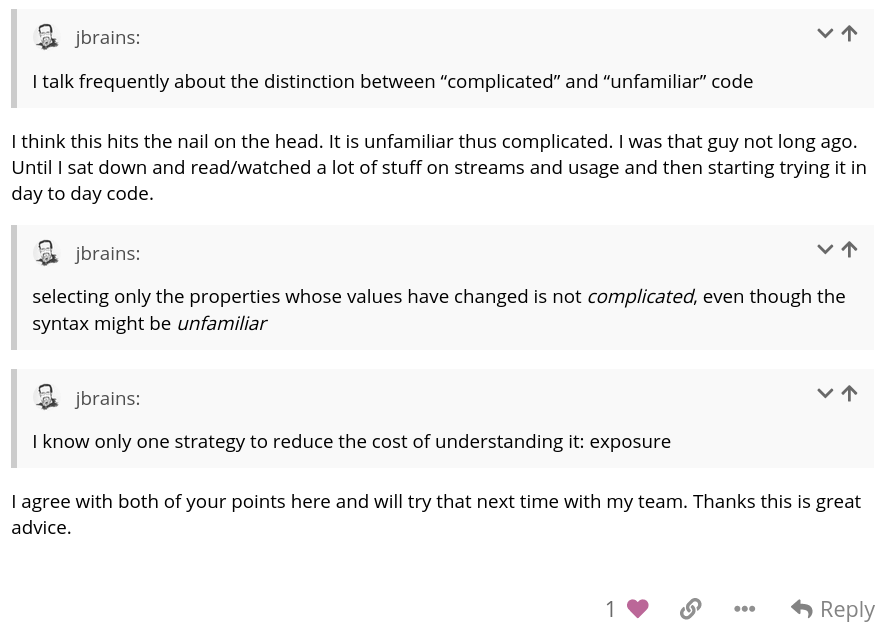
One member was experiencing conflict as a result of a difference of opinion regarding whether code was "clear" or, as programmers tend to say, "readable". J. B. shared a model of understanding so-called "readability" that cuts through the apparent conflict over objective goodness to what likely lies beneath the bluster: that people suspect or even fear what they see as unfamiliar. This creates confusion when they continue to articulate their resistance using words like "complicated" and "over-engineered". It helps to see these patterns of resistance and, as Dale Emery once taught J. B. to do, use a person's resistance as a resource for information about what might be going on internally for them.
Real pain, deep struggle
We spend large amounts of time at our jobs. We have dreams, expectations, worries, and fears. Our experiences on the job deeply affect how we live our lives. J. B. encourages members to bring their entire selves to the group, including opening up about deeply personal issues rooted in how they feel about their jobs: dissatisfied, resentful, trapped, stuck, disillusioned, frustrated, tired, numb. He wants members to feel safe to open up as much or as little as they want about these topics, and some do.
This is exactly where J. B. employs the most powerful of his coaching techniques: paying exquisite attention, asking powerful questions, simplifying thought patterns, debugging motivation blockages, cultivating psychological safety. In the process, he helps members confront their pain in a caring environment that allows them to reach a renewed feeling of optimism and hope. Not every members wants this deeper level of personal involvement, but it is available to those who ask.
The actual topics we've discussed in Office Hours
Here is a brief list of topics we have discussed during Office Hours sessions in 2025 and 2026.
- Burnout from the constant drumbeat of deadlines, the incessant directions to "just do what you're told", the lack of challenge and opportunity to continue to learn and develop skills.
- Managing individual workloads: "How many tasks should I take on per week?"
- What do I do when I notice that I don't feel compassion for my colleagues the way I once did?
- Struggling to work with colleagues who aren't as eager to improve as you are.
- How to determine whether a freelancer is giving away too much for free as lead generators?
- Dealing with the regret that comes from having hired someone and discovering a huge difference between your expectations and what they have delivered so far.
- The individual journeys that computer programmers are taking as they learn about software design through unit testing and refactoring.
- Struggling with the feeling of constantly falling behind, of not learning enough. How do I choose what to learn next? How do I stay motivated to practise?
- Choosing strategies and devising plans for ethically influencing co-workers to change the way they work.
- Making peace with having no control over the freelancing sales pipeline, in the face of financial uncertainty and even fear.
- How do I share information that people are going to dislike, when I fear that would cost me a job opportunity?